WEDDING PLANNING
Practical Reception Planning From Someone Who Has Run The Room.
A useful timeline does more than assign times. It connects the ceremony, guest experience, formal moments, music, vendors, and dance floor—so the couple is not managing the reception while trying to enjoy it.
STRUCTURE FIRST
Decide how the evening should move before collecting hundreds of songs.
ONE CLEAR LEAD
Give someone responsibility for what is happening now and what must be ready next.
FLEXIBLE CONTROL
Use the timeline as a shared plan, then adapt quietly when the real room changes.
Free Reception Planning Articles
Start with the question you are working through. These short articles cover reception handoffs, formal events, microphone work and guest requests.
Who Is Responsible for the Wedding Reception Timeline?
Decide who will watch the reception handoffs and confirm the people and room are ready before each formal event.
When Should Toasts, Cake Cutting, and Special Dances Happen?
Group formal events thoughtfully, prepare toast speakers and drinks, and choose first-dance placement to fit the reception.
How a Five-Minute Warning Helps Your Wedding Grand Entrance
Give guests a few minutes to find their seats, then confirm the people, names and music before the entrance.
How to Introduce Yourself as a Wedding MC
Establish a useful MC voice with a short introduction or a clear first announcement, then guide the reception.
Wedding Reception Request Cards: A Quiet Alternative to a Big Announcement
Put request cards on tables, let guests bring them to the DJ, and use their suggestions as information.
THE FIRST DECISION
Start With Structure, Not Songs.
Music sits on top of the reception structure. First identify when guests arrive, how the couple enters, how dinner is served, who is speaking, which formal events are included, and what must happen before open dancing begins.
Those decisions reveal where announcements, music cues, vendor coordination, and flexible timing are actually needed.
Build the frame first:
- Guest arrival and cocktail period
- Introductions and opening moments
- Meal service and toasts
- Formal dances and activities
- Open dancing
- Closing the night
A RECEPTION IN SIX PHASES
Plan The Evening As A Sequence—Not One Long List.
01
Arrival
Know where guests go, what happens if photographs run long, and who can authorize a change.
02
Introductions
Confirm names, pronunciation, entrance order, music, and where each person goes after entering.
03
Meal & Toasts
Coordinate with catering before inviting guests to eat and prepare speakers before announcing them.
04
Formal Moments
Group the moments needing broad attention while the right guests and vendors are ready.
05
Open Dancing
Begin when the remaining formal schedule will not repeatedly stop the dance floor.
06
The Close
Decide on the final dance, send-off, transportation notice, and venue deadline.
WHO OWNS THE FLOW?
Give The Timeline One Clear Owner.
Someone needs to know what is happening now, what should happen next, and what must be ready before that transition begins. The title may be DJ, MC, planner, coordinator, bandleader, or trusted friend. The responsibility cannot remain vague.
For Northern Colorado DJ events, timeline management and MC work are major parts of the service. Jason establishes his role through a useful first announcement or a short introduction. One capable primary MC voice helps guests follow the reception.
Before directing the room, confirm:
- The couple is ready
- Speakers are present
- The photographer is in position
- Catering is ready
- The venue team knows the transition
Protect The Moments—and The Dance Floor.
Group Formal Events
When the couple’s preferences allow it, place toasts, cake, special dances, and similar moments in a logical group before open dancing. Repeated restarts cost momentum.
Prepare People First
Do not announce a toast and then search for the speaker. A short private check prevents an awkward public delay and gives every vendor the warning they need.
Coordinate Quietly
Use short check-ins, eye contact, and private signals. Guests do not need a running explanation of every behind-the-scenes adjustment.
Use A Repeatable Attention Sequence.
Important announcements work best when the room is prepared to listen.
1. Lower
Bring the music down smoothly.
2. Ask
Clearly request the room’s attention.
3. Wait
Let attention actually shift.
4. Direct
Give the instruction briefly.
5. Move
Begin the moment or restore music.
MUSIC AND REQUESTS
Treat Preferences As Planning Information.
Favorite artists, genres, eras, and do-not-play choices reveal who the couple is and who may be in the room. Organize music into practical groups: moment-specific songs, highest-priority requests, play-if-it-fits choices, and firm exclusions.
Guest requests add another source of information. Jason uses request cards at tables and may circulate quietly during dinner. Guests bring completed cards to the DJ. Requests help read the room; a request is information, not a promise.
Four useful music groups
- Formal-moment songs
- Highest-priority reception requests
- Play-if-it-fits ideas
- Firm do-not-play choices
THE DEEPER SYSTEM
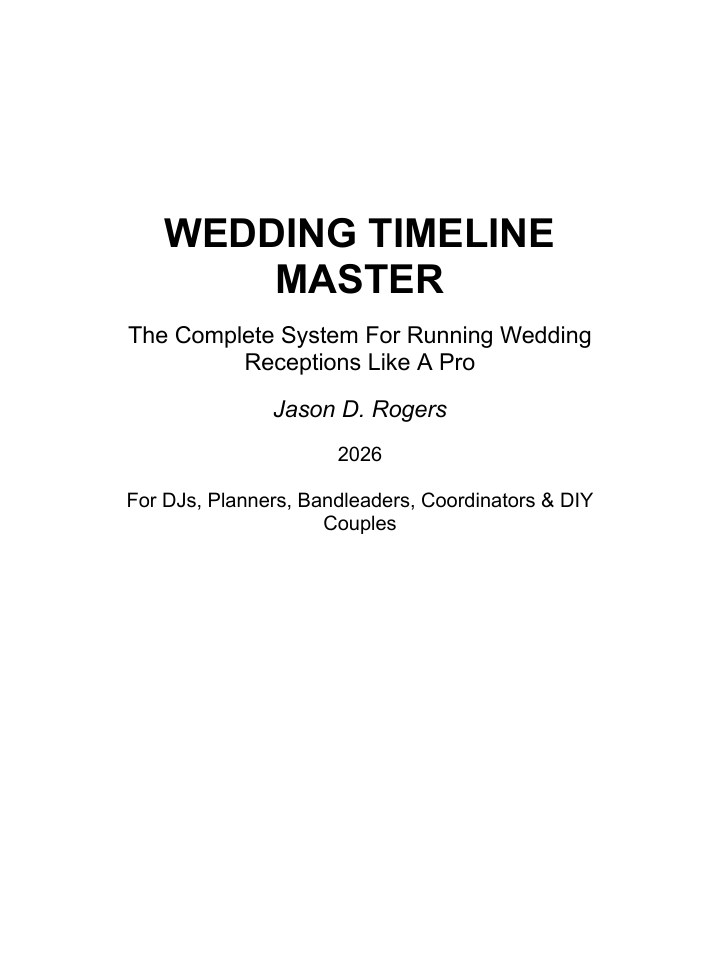
Wedding Timeline Master
Jason D. Rogers’ book goes deeper into reception phases, room attention, vendor coordination, microphone work, formal-event placement, and dance-floor pacing.
The goal is not a rigid minute-by-minute script. It is a working system that helps one person interpret the plan in the real room.
A Planning Map You Can Start Today
- Ceremony start, expected length, and sound needs
- Guest arrival plan and delay contingencies
- Introduction names, pronunciation, order, and music
- Dinner format, timing, and catering readiness
- Toast speakers, order, microphone, and photo notice
- Special dances, cake, and formal activities
- Open-dance start, highest-priority requests, boundaries, and requests
- Final song, send-off, transportation, and venue deadline
DJ & MC Services
See how planning, announcements, requests, room management, and music work together.
Real Wedding Proof
See examples of ceremonies, introductions, formal moments, and reception decisions.
Local Planning
Use city and venue resources grounded in real Northern Colorado experience.
Wedding Planning FAQ
When should we begin building the reception timeline?
Begin once the ceremony time, reception location, meal approach, and major formal moments are known. Add detail as the venue and other professionals confirm their requirements.
Who should control the timeline during the reception?
Choose one clear lead and define how that person coordinates with the planner, venue, photographer, catering team, and DJ. Multiple professionals can contribute, but guests should receive one clear direction during formal moments.
How much of the music should we choose?
Choose the formal songs, the highest-priority requests that matter most, useful style preferences, and firm exclusions. Leave enough room for the DJ to respond to the guests and the timeline.
Want A DJ And MC Who Can Help Run The Plan?
Share your date, venue, and the part of the reception you are still trying to solve. Jason can review the fit and the next planning step.

